

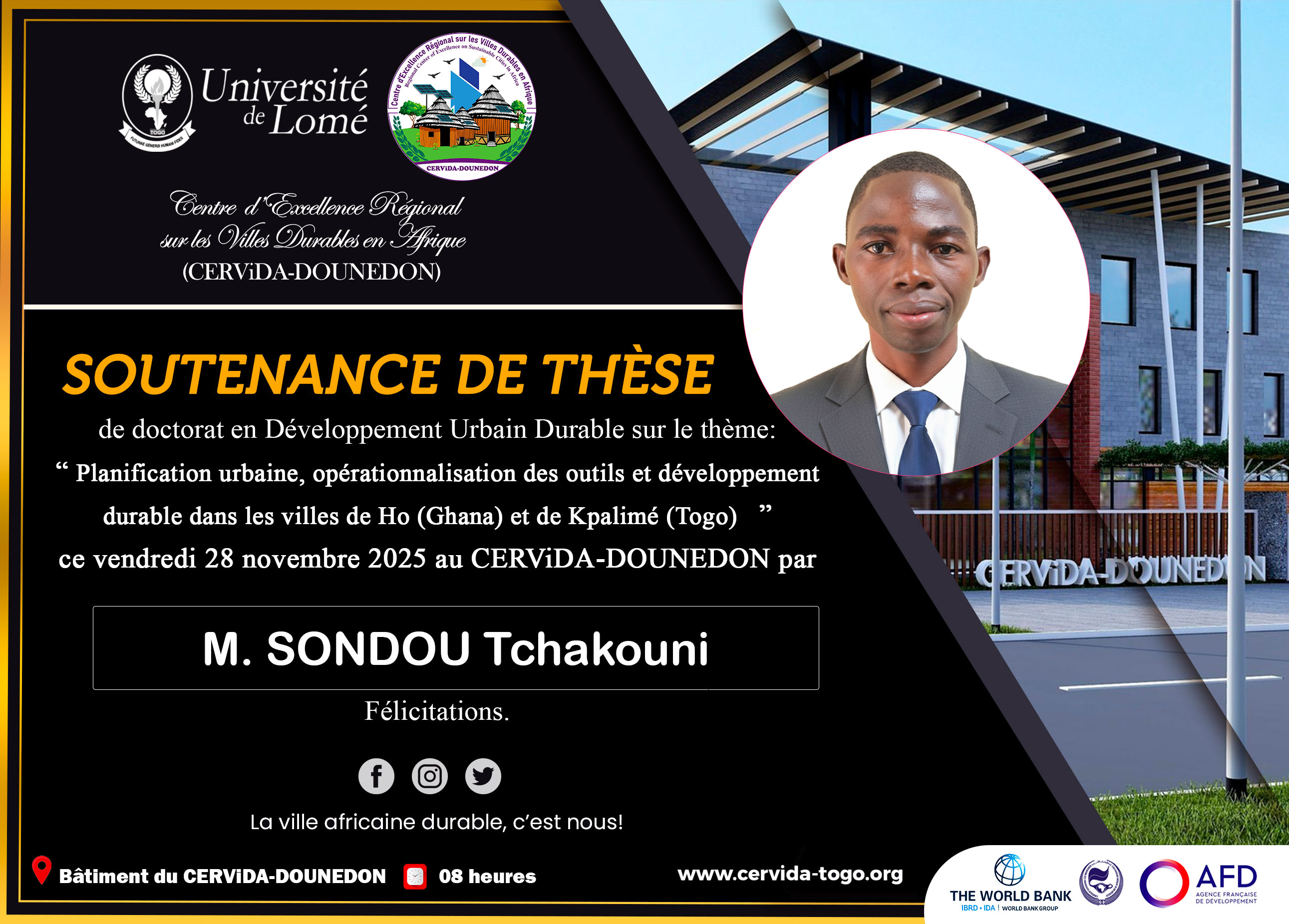
Planification urbaine, opérationnalisation des outils et développement durable dans les villes de Ho (Ghana) et de Kpalimé (Togo)
 26 Novembre 2025
Résumé :
Les villes de Ho (Ghana) et de Kpalimé (Togo) sont confrontées à une urbanisation rapide qui pose de sérieux défis en matière de gestion de l’espace, d’infrastructures et de protection de l’environnement. La planification urbaine dans ces deux villes doit permettre de répondre à ces enjeux tout en prenant en compte la participation citoyenne, la cohérence des instruments de planification et les impacts environnementaux. Une méthodologie combinant des analyses géospatiales et temporelles, ainsi que des entretiens et des enquêtes participatives a été utilisée pour évaluer l’implication des citoyens dans la planification urbaine. Il ressort de cette analyse que l'artificialisation des sols dans ces deux villes, alimentée par une urbanisation accélérée, est en forte croissance et engendre une dégradation significative du cadre de vie. Cette expansion urbaine nécessite une stratégie de planification urbaine adaptée aux enjeux écologiques et sociaux. Cependant, une lacune subsiste entre les cadres théoriques de planification et leur mise en œuvre concrète à Ho et à Kpalimé. Les outils de planification existants sont souvent inefficaces en raison d'un manque de ressources, de coordination interinstitutionnelle et d'un suivi insuffisant des projets. De plus, les outils de planification sont souvent incohérents, mal adaptés aux réalités locales. L'absence d'une approche intégrée et durable, combinée à une faible participation citoyenne et à des capacités administratives limitées, rend la gestion de cette expansion urbaine plus complexe. Si la participation des citoyens améliore la transparence et la pertinence des projets, elle reste insuffisante dans le contexte actuel. Pour que la planification urbaine favorise un développement durable à Ho et à Kpalimé, il est crucial d'améliorer l'efficacité des outils de planification, en intégrant des approches écologiques et sociales plus inclusives. La participation citoyenne et une meilleure coordination des acteurs locaux sont essentielles pour construire des villes résilientes et durables.
Mots clés : Ville secondaire, Planification urbaine, Développement durable, Croissance urbaine, Opérationnalisation des outils, Kpalimé, Ho.
Urban planning, operationalizing tools and sustainable development in the cities of Ho (Ghana) and Kpalimé (Togo).
Abstract:
The cities of Ho (Ghana) and Kpalimé (Togo) are facing rapid urbanization, which poses serious challenges in terms of land management, infrastructure and environmental protection. Urban planning in these two cities needs to respond to these challenges, considering citizen participation, coherence of planning instruments and environmental impacts. A methodology combining spatial and temporal analysis, interviews and participatory surveys was used to assess citizen participation in urban planning. The analysis showed that the urban sprawl in these two cities, fuelled by accelerated urbanization, is growing rapidly and causing significant deterioration in the living environment. This urban expansion requires an urban planning strategy adapted to the environmental and social challenges. However, there is still a gap between theoretical planning frameworks and their practical implementation in Ho and Kpalimé. Existing planning tools are often ineffective due to a lack of resources, inter-institutional coordination and insufficient monitoring of projects. In addition, planning tools are often coherent but poorly adapted to local realities. The lack of an integrated and sustainable approach, combined with low levels of citizen participation and limited administrative capacity, makes managing this urban expansion more complex. Although citizen participation improves the transparency and relevance of projects, it remains insufficient in the current context. For urban planning to promote sustainable development in Ho and Kpalimé, it is crucial to improve the effectiveness of planning tools by integrating more inclusive environmental and social approaches. Citizen participation and better coordination of local actors are essential if we are to build resilient, sustainable cities.
Keywords: Secondary town, Urban planning, Sustainable development, Urban growth, Tools implementation, Kpalimé, Ho